
<prologue>
I started a blog called “The Baby Boomer Generation’s Miscellaneous Blog”(Dankai-sedai no garakutatyou:団塊世代の我楽多(がらくた)帳) in July 2018, about a year before I fully retired. More than six years have passed since then, and the number of articles has increased considerably.
So, in order to make them accessible to people who don’t understand Japanese, I decided to translate my past articles into English and publish them.
It may sound a bit exaggerated, but I would like to make this my life’s work.
It should be noted that haiku and waka (Japanese short fixed form poems) are quite difficult to translate into English, so some parts are written in Japanese.
If you are interested in haiku or waka and would like to know more, please read introductory or specialized books on haiku or waka written in English.
I also write many articles about the Japanese language. I would be happy if these inspire more people to want to learn Japanese.
my blog’s URL:団塊世代の我楽多(がらくた)帳 | 団塊世代が雑学や面白い話を発信しています
my X’s URL:団塊世代の我楽多帳(@historia49) on X
(Reference) Original article in Japanese
・ギリシャ神話の「オリュンポス12神」以外の女神たち(その3)
Previously, I introduced the “Twelve Olympians” of Greek mythology, but there are many other gods and goddesses as well.
Therefore, this is the third installment in our series introducing the goddesses of Greek mythology in alphabetical order.

1. Goddesses beginning with the letter “N”
① Nike (Nike, Naiki): Goddess of victory. Daughter of Styx, attendant of Athena.

Nike is the daughter of Pallas and Styx (the river of the underworld), both Titan gods.
Her brothers were Zelos (inspiration), Kratos (strength), and Bia (violence).
During the Titanomachy, the war between the Titans and the Olympian gods, she sided with the Olympians at Styx’s command and was rewarded by Zeus.
She is generally depicted as a winged woman. She is a companion of Athena, but is sometimes considered an incarnation of Athena.
In the statue of Athena, the principal image of the Parthenon in Athens, her wings were resting on her right hand.
The famous statue, “Winged Victory of Samothrace” (in the Louvre Museum), excavated on the island of Samothrace, is well-known.
In English, her name is pronounced “Nike,” and the sports equipment manufacturer Nike derives its name from this goddess. Their trademark is inspired by the goddess’s wings.

② Nyx: Goddess of night. The deification of “night”.

According to Hesiod’s Theogony, Nyx was the daughter of Chaos and the sister of Erebus (the underworld).
She bore Hemera (day), Aether (the clear air of the heavens), and Charon (the ferryman of the underworld) with Erebus. She also fathered numerous other gods on her own.
She fathered the abominable Moros (death’s fate), Keres (death’s destiny), and Thanatos (death), as well as the family of Hypnos (sleep) and Oneiros (dreams). She is also said to have fathered Momus (accusation) and Oijus (suffering).
In addition, she is the daughter of Nemesis (righteous revenge), Aphate (deception), Philotes (lust), Geras (old age), and Eris (strife).
③ Nemesis: Goddess of righteous indignation. The personification of the gods’ anger towards human arrogance (hubris).

Nemesis is the personification of the gods’ wrath and punishment for human insolence (hubris). She is primarily depicted as a winged woman.
According to Hesiod’s *Theogony*, she is the daughter of Nyx (the night).
Zeus attempted to mate with Nemesis, but she escaped by changing her form. When she transformed into a goose, Zeus transformed into a swan and finally mated with her, and the goddess laid an egg.
A shepherd found this egg and presented it to Queen Leda of Sparta, from which Helen and the Dioscuri were born.
However, there is also a tradition that Zeus, in his swan form, mated with Queen Leda.
Nemesis is said to have punished Narcissus for rejecting the love of the nymph Echo.
2. Goddesses beginning with “H” “P” “B”
① Panacea: Goddess of healing. Daughter of Asclepius
She was the granddaughter of Apollo, the god of medicine, and one of Asclepius’s daughters. Her name means “all-healing,” and it became the name of a miraculous elixir that medieval alchemists considered an ingredient in elixirs and the Philosopher’s Stone.
Even today, it is used to mean “panacea” (a cure-all).
② Harmonia: Goddess of harmony

Harmonia is said to be the daughter of Ares and Aphrodite. She married Cadmus, the founder of Thebes, and bore him children, but they all died tragically. To prevent further divine curses from befalling Thebes, she left the city with Cadmus and embarked on a wandering journey.
She held Cadmus tightly as he transformed into a snake, and eventually transformed herself into a snake as well. Afterward, the two lived in the fields of Elysium.
The Olympian gods attended Cadmus and Harmonia’s wedding. It was the first wedding between humans, and all the gods visited Cadmus’s house, bringing gifts.
Among the most famous gifts were a peplos (long robe) and a necklace made by Hephaestus.
These are said to be gifts from Athena and Hephaestus, or gifts that Zeus gave to Europa and Cadmus inherited, or gifts from Aphrodite.
These gifts bestowed beauty and grace upon the wearer.
There is also a theory that Athena and Hephaestus, hating that Harmonia was the daughter of Ares and Aphrodite, soaked a robe in a love potion and gave it to her, which became a curse on Harmonia’s descendants.
Other stories include Hermes giving her a lyre, Cadmus giving her a luxurious robe, and Demeter promising her fertility.
③ Pandia: Daughter of Zeus and Selene
Her beauty was said to be outstanding among the gods, and she had sisters Else of the Dew and Nemea.
④ Bia: Deification of strength, bravery, and violence
Daughter of the Titan gods Pallas and Styx, she had siblings Nike (victory), Kratos (strength), and Zeus (zeal), all of whom served as close advisors to Zeus.
Aeschylus states that Bia, along with Kratos and Hephaestus, bound Prometheus.
⑤ Pieris (plural: Pierides): Goddesses of music and literature. Also considered another name for the Muses.

These were the nine daughters born to King Pierus of Pieria and Eupipe of the Kingdom of Pioneer.
They were nine sisters with the exact same names as the Muses, and are sometimes identified with them.
The most famous mythological source depicting the Pieris is Ovid’s “Metamorphoses.”
The Pieris, born in Pieria, were confident and arrogant. They challenged Calliope, the eldest of the Muses, to a singing contest, lost, and were transformed into magpies.
⑥ Hygieia: Goddess of health and hygiene. Daughter of Asclepius.

Hygieia was the daughter of Asclepius, the god of medicine (son of Apollo, the father of medicine), and was worshipped as an attendant to her father in the Asclepius cult. In Roman mythology, she is known as Salus.
Like her father, she is often depicted as a young woman accompanied by a snake, sometimes carrying a jar (or cup) that appears to contain medicine or water.
The “Cup of Hygieia,” featuring this snake and cup, is frequently used as a symbol of medicine.
As the Asclepius cult spread, the worship of Hygieia also grew stronger. Influenced by her female status, she later became a goddess who protected women’s health, particularly with great power over so-called women’s diseases. It became fashionable among women at the time to wear her image or small statues as hair ornaments.
The name Hygieia means “health” in Greek and is considered the origin of the English word “hygiene.”
⑦ Hypnos: Goddess of Sleep

Hypnos, meaning “sleep” in Greek, is the personification of sleep. He is equivalent to Somnus in Roman mythology.
According to Hesiod’s *Theogony*, Hypnos is the daughter of Nyx (night), and her siblings include Thanatos and Moros, gods representing “death.” Oneiros (dream) is also a sibling.
Together with her brother Thanatos, she resided in Tartarus, far below the earth. When Nyx brought night to the earth, Hypnos accompanied her, inducing sleep in people.
While her brother Thanatos was known for his ruthless nature, Hypnos is described as gentle and kind, and death is considered the final sleep granted by Hypnos.
⑧ Philyra: The personification of the “linden tree”
Daughter of Oceanus, she bore the centaurs Chiron and Drops with Cronus.
When Zeus was a child, Philyra lived on an island off the Black Sea coast. There, Cronus transformed into a horse and mated with Philyra.
However, they were discovered by Rhea, and Cronus escaped in horse form. Philyra also left the island and gave birth to Chiron in the Pelasgian Mountains.
Another version of this story suggests that while searching for Zeus, who was hiding, Cronus transformed into a horse in Thrace and mated with Philyra, giving birth to Chiron. However, Philyra was saddened by the appearance of her newborn son and begged Zeus to transform him into a “Bodhi tree” (Philyra).
⑨ Philotes: Deification of lust
According to Hesiod’s “Theogony,” he was the son born to Nyx, the goddess of night.
Originally human, he was later made a goddess.
⑩ Psyche (Psyche, Psyche, Psychi): Meaning “heart” or “soul.” Originally human, she was later made a goddess.

Psyche appears as an episode in Apuleius’s Latin novel, “The Golden Ass.”
Three princesses of a certain kingdom were all beautiful, but the youngest daughter, Psyche, was so beautiful that she commanded the reverence of those who should have dedicated her to Venus (Aphrodite), the goddess of beauty.
Venus, who never imagined she could be surpassed by a human woman, commanded her son, Cupid (Eros), to use his bow and arrow of love to cause Psyche to fall in love with a lowly man.
This mischievous god of love gladly obeyed his mother’s command, but accidentally wounded himself and became captivated by his love for Psyche.
Worried that no suitors had come for Psyche, her parents consulted Apollo (Apollon), but the oracle was terrifying: “Place your daughter on a mountaintop and marry her to a viper-like villain who flies all over the world and is feared even by the gods and the underworld.”
While the people grieved, Psyche alone decided to obey the oracle and was carried up the mountain.
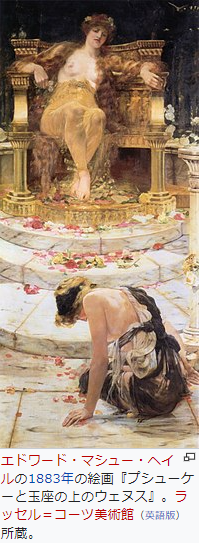
Zephyrus carried Psyche to a magnificent palace, seemingly otherworldly. Within the palace, an unseen voice declared, “Everything here belongs to Psyche,” and everything—food, music, everything—was prepared to her liking. Her husband only appeared at night in her bedchamber; she could not see him.
Psyche enjoyed her life in the palace, but soon she longed for her family. She tearfully persuaded her reluctant husband to invite her two sisters to the palace. Jealous of Psyche’s luxurious life, her sisters told her that her unseen husband was actually a serpent intending to fatten her up before eating her, and urged her to kill him with a razor while he slept.
Believing their words, Psyche approached her sleeping husband with a candle, intending to kill him. However, the image of a majestic god was revealed.
Startled, Psyche dropped the candle wax, burning Cupid. Enraged by his wife’s betrayal, Cupid flew away.
Psyche, finally realizing her sisters’ machinations, went to them, only to be told another lie: “Cupid intends to marry you.”
Delighted, the sisters, believing Zephyrus would carry them to the palace, leaped from a cliff, but the wind did not carry them, and they fell to their shattered pieces.
Meanwhile, Venus, furious at her son’s scandal, offered a reward of Venus’s own kiss to capture Psyche.
Frightened, Psyche sought refuge from Ceres, but Ceres refused, citing her relationship with Venus.
She then sought refuge from Juno, but Juno refused, citing the law that she was forbidden from harboring a runaway slave.
Thus, Psyche, who pursued love but was trapped by the constraints of the world, resigned herself to her fate and surrendered to Venus.
Venus captured Psyche, punished her, and imposed one impossible task after another. However, when ordered to sort a large quantity of grain, ants appeared from nowhere to help; when ordered to retrieve the wool of a ferocious golden raschnee, reeds by the river advised her on how to obtain the wool; and when ordered to draw water from a spring inhabited by dragons, Jupiter’s eagle, beloved by Cupid, brought the water for her. With these miraculous helpes, Psyche overcame Venus’s challenges.
Frustrated, Venus ordered Psyche to obtain some beauty from Proserpina, Queen of the Underworld, to compensate for her weakened appearance from tending to her son Cupid’s burns.
Psyche, having successfully received a share of beauty, became anxious that her own beauty would fade and she would lose Cupid’s love. Despite being warned not to open the box, she did. However, inside was the Sleep of the Underworld.
After his wounds healed, Cupid removed the Sleep of the Underworld from his unconscious wife, gathered it in the box, and asked Jupiter to intercede on his behalf.
Jupiter agreed to intercede on the condition that Cupid would introduce him to a suitable woman if he found one.
Jupiter gave Psyche nectar, the drink of the gods, allowing her to join the ranks of the gods. He explained that “Psyche is no longer human, so this is not a marriage of unequal status,” and Venus finally accepted.
Thus, the “soul” gained love, and a child named Voluptas (meaning joy, pleasure) was born to them.
When Psyche, now a goddess, is depicted in paintings, she is often shown with butterfly wings on her back.


⑪ Britomartis: Goddess of mountains and hunting in the Minoan civilization

Britomartis was the goddess of mountains and hunting in the Minoan civilization, but she was adopted by the Mycenaean civilization and became part of Greek mythology.
For the Greeks, Britomartis (meaning “sweet maiden” or “sweet virgin” in the Crete dialect) and Dictynn (hunting net) were mountain nymphs (mountain spirits) and were identified with Artemis and Apaia (the forest virgin goddess) of Aegina.
⑫ Pleione: Mother of the Pleiades
Pleione was one of the 3,000 daughters of Oceanus and Tethys, the Oceanids.
She became the wife of Atlas and the mother of seven daughters known as the Pleiades (Maia, Alcyone, Merope, Celaeno, Electra, Sterope, and Taygete).
⑬ Hecate: Goddess of the underworld. It is also said to govern the moon.

Hecate is said to be either the feminine form of Hecatos, another name for the sun god Apollo in ancient Greek, or to mean “will.”
She is also said to be derived from Heket, the Egyptian goddess of fertility and resurrection.
She was also called “Goddess of Death,” “Protector of Sorceresses,” “Spiritual Guide,” “Mother of Lamia,” “Princess of the Dead,” and “Invincible Queen.”
Aconite, dogs, wolves, mares, snakes (symbols of immortality), torches (symbols of moonlight), knives (symbols of midwifery), and natural stones with indentations are considered symbols of Hecate.
⑭ Hesperis: Goddess of Twilight
Daughter of Hesperus, the evening star, she bore seven beautiful daughters with Atlas.
⑮ Hebe: Goddess of Youth. The personification of “youth.” Daughter of Hera and wife of Heracles.

Hebe means “youth” or “youth (and its beauty),” and is the goddess who personifies youth.
In Hesiod’s “Theogony,” she is described as wearing a golden crown and golden shoes. In artwork, she is often depicted as a beautiful maiden in a sleeveless dress, sometimes holding a wine cup and water pitcher, and sometimes with wings on her back.
⑯ Peme: Goddess of “rumor” and “fame”

Peme is the goddess who personifies “rumors” and “fame.” She favors good rumors and is angered by bad ones.
She is considered the daughter of Gaia or Elpis and is depicted as “the woman who initiates and develops conversations.” She had a temple in Athens.
Peme is said to have observed various matters concerning gods and humans, speaking what she saw and heard, initially in a whisper, then gradually raising her voice, repeating this until everyone knew.
She is equivalent to Fama in Roman mythology.
⑰ Hemera (Hemera, Hemera, Hemele): Goddess of day. The personification of “day.”

Hemera means “day” or “daylight” in Greek, and she is the goddess who personifies day.
⑱ Phoebe: Goddess of light. A Titan.

Phoebe was the daughter of Uranus and Gaia, and the grandmother of Apollo, Artemis, and Hecate.
Her name means “shining woman,” and she is considered a goddess of light. This name is also used as an appellation for Artemis, the goddess of the moon.
According to one theory, Phoebe was one of the rulers of the Delphi Oracle, third in line after the earth goddess Gaia and the Titan goddess Themis, and later ceded it to her grandson, Apollo.
⑲ Horae (plural: Horae): Presiding over time, seasons, and order. They are considered three sisters, but their names are not consistent.

The Horae were the three daughters of Zeus and Themis, and are considered sisters of the Moirai, the three goddesses of fate.
Normally, the Horae are seen as goddesses of two aspects: the regular changes of the seasons and the order of human society. With their meteorological characteristics, they protect the natural order and are also important for moral order.
They are also guardians of the cloud gates connecting heaven and earth, and they part the clouds at the gates to heaven when the gods leave Olympus in their chariots, such as when removing the horses from Hera’s chariot.
When Aphrodite landed on Cyprus, the Horae dressed her up and took her to Mount Olympus.
When Zeus sent Pandora to earth to destroy humanity, the Horae adorned her head with a crown of flowers.
They are depicted as three elegant and beautiful maidens holding flowers or plants.
3. Goddesses whose names begin with the letter M
① Maia (Maya): Mother of Hermes

Maia is one of the Pleiades, the seven daughters of the giant Atlas and Pleione.
They are believed to have been born on Mount Cyrene in Arcadia.
Maia is considered the eldest daughter and gave birth to Hermes, son of Zeus, in a cave on Mount Cyrene.
② Mnemosyne: Goddess of memory. The personification of “memory.”

Mnemosyne is the daughter of Uranus and Gaia, and a member of the Titans.
According to Hesiod’s Theogony, Mnemosyne was the mistress of the hill Eleuthera. She lay with Zeus in Pieria for nine days, giving birth to the nine Muses, who were meant to alleviate suffering for people.
Mnemosyne is said to have begun naming the Muses.
The asteroid “Mnemosyne,” asteroid number 57 in the asteroid belt, is named after Mnemosyne.
③ Metis: Goddess of intellect and wisdom. Zeus’s first wife.
Metis is one of the 3000 Oceanids, daughters of Oceanus and Tethys, and is counted among the Titans.
She was Zeus’s first wife and the mother of Athena.
Cronus, the youngest of the Titan gods, overthrew his father Uranus at the command of his mother Gaia and became king of the gods.
However, Uranus prophesied that Cronus would also be overthrown by his own children, so he devoured each child as they were born.
The Spanish painter Goya (1746-1828) painted “Saturn Devouring His Son,” based on Roman mythology; Saturn corresponds to Cronus in Greek mythology.

Cronus’s wife, Rhea, grieved over this and consulted Gaia. Gaia gave birth to their youngest son, Zeus, outside the dark of night. Rhea then brought back a stone, disguised as Zeus, and tricked Cronus into swallowing it, thus saving him.
Zeus was raised on Crete, and upon reaching adulthood, he, along with his mother Rhea and the goddess of wisdom, Metis, decided to avenge his devoured siblings.
Zeus ordered Metis to mix an emetic she had prepared with nectar (divine drink) and successfully tricked Cronus into drinking it.
Cronus first vomited up the stone he had swallowed, disguised as Zeus, and then vomited up Poseidon, Hades, Hera, Demeter, and Hestia, in the reverse order of ingestion.
However, one account states that Metis was not involved, and Zeus himself struck Cronus on the back to induce vomiting.
Zeus, joined forces with his surrendered siblings, won the Titanomachy, a war against Cronus and the other Titans. It is said that Oceanus, Metis’s father and the eldest of the Titans, did not participate in this battle.
Afterward, Zeus, now king of the gods, took Metis as his wife. However, one account suggests that Metis was not Zeus’s wife, but rather conceived after fleeing from him.
Upon learning of this, Gaia and Uranus prophesied that Metis’s child would be more intelligent and courageous than Zeus, and if a boy, he would threaten Zeus’s position. Therefore, fearing that his son would usurp his power, just as his grandfather Uranus and father Cronus had done, Zeus swallowed Metis as a precaution.
Another account suggests that Metis transformed into various forms to escape being swallowed, but was ultimately consumed while transformed into a fly. This event led to Metis becoming one with Zeus, and Zeus came to be worshipped as the god of wisdom.
However, it was too late; Metis was already pregnant, and the fetus had moved into Zeus’s head and was alive. Furthermore, Metis made armor for the fetus, an act that caused Zeus severe headaches.
When the month of birth arrived, Zeus could no longer bear the pain and consulted Prometheus, Hephaestus, and Hermes by Lake Tritonis in Libya. He ordered Hephaestus to split Zeus’s head open with an axe.
From within, a goddess who was already an adult and fully armored burst out. This was Athena. There is a painting by René-Antoine Houasse, “The Birth of Athena” (before 1688) (image below).

After this, Metis began to predict good and evil within Zeus’s body.
④ Moirai (plural: Moirai): The three goddesses of fate. They are said to be Clotho, Lachesis, and Atropos.

The name Moira originally comes from the Greek word for “allocation.” For humans, “lifespan” was of greatest interest as something that was allocated to them, and therefore, they became associated with life, death, and life itself.
They were also associated with Eileithyia, the goddess of childbirth, and eventually came to be considered the “goddesses of fate.”
4. Goddesses beginning with the “R” “L”sound
① Rhea (Leia, Leah, Leia): A Titan god. Goddess of the earth. Mother of Zeus and his brothers.

Rhea’s father was Uranus and her mother was Gaia. The details of what happened after her husband Cronus swallowed their children are described in detail in the section on “Metis.”
② Leto: Mother of Apollo and Artemis

She was the daughter of the Titan gods Coeus and Phoebe, and the sister of Asteria. There is also a theory that she was the daughter of Poulus and Phoebe.
She gave birth to Apollo and Artemis, sons of Zeus.
Leto is depicted wearing black robes and is considered the most gentle goddess among the gods. Because she bore Apollo and Artemis with Zeus, who had transformed into a quail, she incurred the intense jealousy of Hera.